24 Famous People From North Dakota and Their Real Connections
The state’s best-known names did not all begin here in the same way. These are the hometowns, schools, studios, depots and second chances behind 24 remarkable lives.
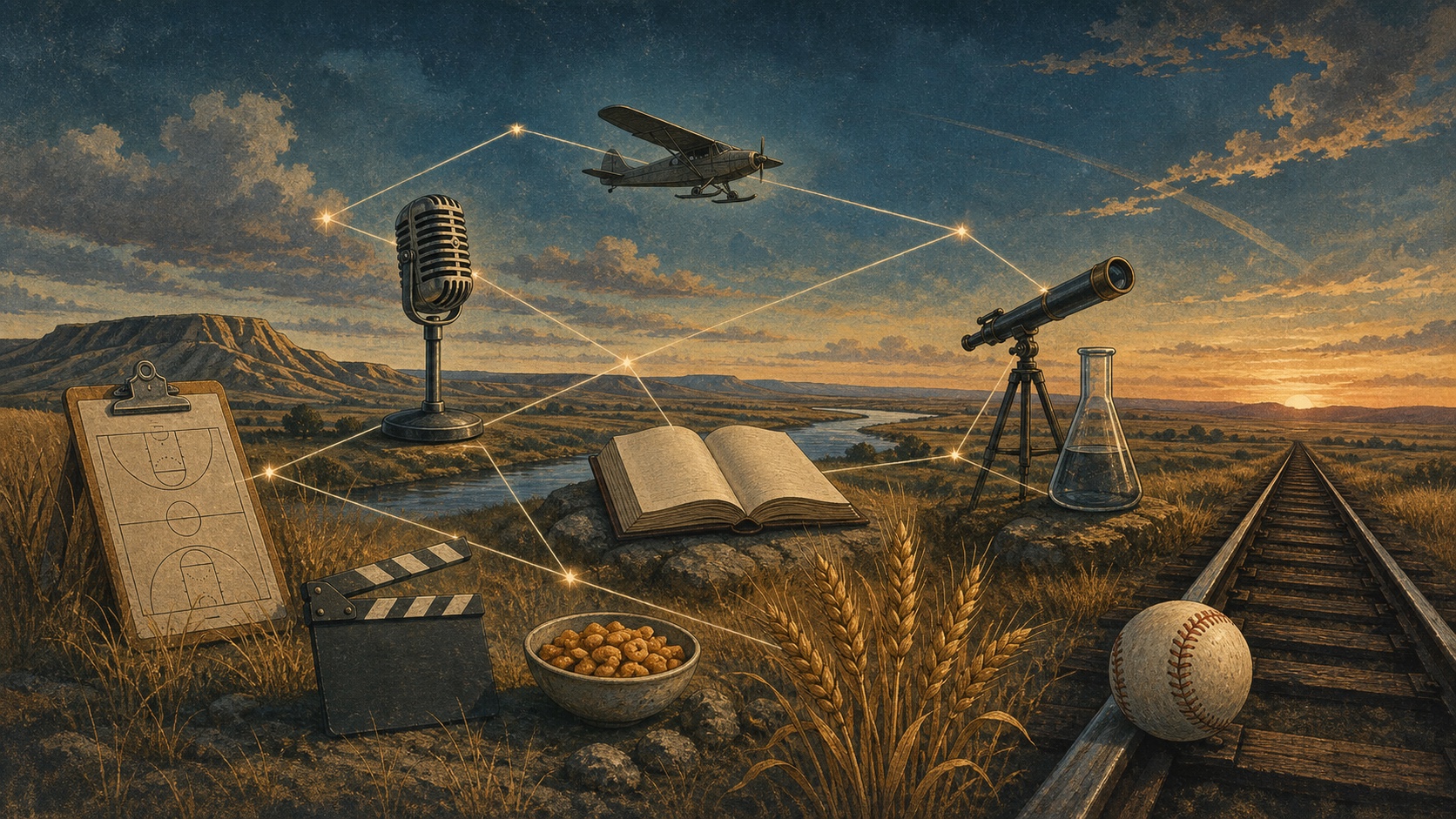
One became Peggy Lee in a Fargo radio studio. One learned basketball in Williston before winning 11 NBA championships as a coach. One grew up in Hatton, carried Alaska mail in an open cockpit and helped redraw the map of polar flight. Another worked from a Valley City clothing store to pull families beyond the reach of Nazi Germany.
There is no single North Dakota success story hiding behind those lives. There are railroad towns and tribal homelands, high-school gyms and dance halls, an aviation program that began with two airplanes, and a recipe shared from a home kitchen. Some of the people below were born in the state. Some arrived as children. A few came for a consequential chapter and carried it into the rest of their work.
This is not a fame ranking, and it is not a roll call assembled from birthplace fields. It is a guide to 24 documented North Dakota connections. It shows what those connections do, and do not, allow us to say.
What “from North Dakota” means here
Every entry carries a connection label. Born here means exactly that, but birth alone is not enough for a meaningful profile. Raised or formed here marks substantial childhood, education or early-career work. Long state tie covers people whose important North Dakota years came later. Someone who only passed through does not qualify.
These categories keep the history honest. Roger Maris and Phil Jackson are unmistakably part of North Dakota’s story, but neither was born here. Theodore Roosevelt’s Badlands years mattered enormously, but he remained a New Yorker. Sakakawea’s relationship to the Knife River villages is central and culturally complex; a generic “North Dakota native” label would settle questions the evidence does not.
The list favors people with nationally consequential work and a state connection strong enough to explain, not merely mention. It also crosses fields deliberately. Fame looks different from a boxing ring, a newsroom, an earthlodge village or a patent drawing.
Sports: the long road out of the gym
1. Phil Jackson
North Dakota connection: raised and formed in Williston and at UND; born in Montana. Jackson played multiple sports at Williston High School and basketball at the University of North Dakota before reaching the NBA. His larger record (11 championships as head coach of the Chicago Bulls and Los Angeles Lakers) belongs to professional basketball, but his first sustained competitive education belongs here. Read the full story of Phil Jackson’s North Dakota years.
2. Roger Maris
North Dakota connection: raised and formed in Grand Forks and Fargo; born in Minnesota. Maris starred at Fargo’s Shanley High School and for the Fargo American Legion team before professional baseball. In 1961 he hit 61 home runs for the Yankees, breaking Babe Ruth’s single-season major-league record. His family’s precise first move into North Dakota is inconsistently dated, but the Grand Forks-to-Fargo childhood is secure. Read Roger Maris’s Fargo story.
3. Carson Wentz
North Dakota connection: raised in Bismarck and developed at North Dakota State University; born in North Carolina. At Century High School, Wentz played football, baseball and basketball. At NDSU he became the starting quarterback for two Football Championship Subdivision title teams, then went second overall in the 2016 NFL draft. That progression, not a changeable current roster listing, is the durable North Dakota story. An official Minnesota Vikings account says he was born in North Carolina and raised in Bismarck, correcting player pages that list Bismarck as his birthplace.
4. Darin Erstad
North Dakota connection: born and raised in Jamestown. Erstad left Jamestown for the University of Nebraska, where he was both a baseball All-American and the football team’s punter. The California Angels selected him first overall in the 1995 amateur draft. He later won a World Series with the Angels and earned three Gold Gloves, an unusually versatile route from a prairie high-school athlete to the major leagues.
5. Virgil Hill
North Dakota connection: raised in Grand Forks and Williston; born in Missouri. Hill moved to Grand Forks as a child and later attended high school in Williston. He won an Olympic silver medal in 1984, then held world titles at light heavyweight and cruiserweight. The International Boxing Hall of Fame inductee also brought major title fights home, making North Dakota part of the spectacle rather than merely the place before it.
Music, film and theater: first audiences
6. Peggy Lee
North Dakota connection: born in Jamestown and formed in Wimbledon, Valley City and Fargo. Norma Deloris Egstrom lived above Wimbledon’s railroad depot, sang over KOVC and auditioned at WDAY, where program director Ken Kennedy gave her the name Peggy Lee. Benny Goodman provided the national breakthrough later in Chicago. North Dakota supplied early audiences, radio work and a professional name, but not a simple destiny. Read Peggy Lee’s North Dakota story.
7. Lawrence Welk
North Dakota connection: born and raised on a farm near Strasburg. Welk paid for a professional accordion by playing local dances, then built bands that traveled far beyond Emmons County. His television program began nationally in 1955 and continued in first-run syndication until 1982. The distance is striking, but so is the continuity: an entertainer trained to read a dance floor became a master of the weekly living-room audience.
8. Bobby Vee
North Dakota connection: born and musically formed in Fargo. In February 1959, the teenage Robert Velline and his new band answered a call for performers at the next Winter Dance Party show in Moorhead, after the plane crash that killed Buddy Holly, Ritchie Valens and J. P. Richardson. The fill-in did not confer instant stardom, but it opened a door. As Bobby Vee, he built a durable national recording career.
9. Angie Dickinson
North Dakota connection: born in Kulm and spent roughly her first decade in the state. Dickinson’s father published the local newspaper before the family moved to California during her childhood. Her screen career later ranged from Rio Bravo to the television series Police Woman, which brought a Golden Globe and multiple Emmy nominations. North Dakota was a genuine opening chapter, not the setting of her professional ascent.
10. Josh Duhamel
North Dakota connection: born, raised and educated in Minot. Duhamel graduated from Minot High School and attended Minot State University before moving into modeling and acting. National audiences came to know him through All My Children, Las Vegas and the Transformers films. His hometown link is unusually durable: Minot State named its Summer Theatre stage for the alumnus in 2022.
11. Phyllis Frelich
North Dakota connection: born and raised in Devils Lake. Frelich attended the North Dakota School for the Deaf and Gallaudet, then helped found the National Theatre of the Deaf. She won a Tony Award for originating Sarah Norman in Children of a Lesser God. Her achievement was not simply entering hearing theater; it included expanding whose language, presence and experience could command a Broadway stage.
Exploration, science and aviation: larger maps
12. Carl Ben Eielson
North Dakota connection: born in Hatton and educated at UND. Eielson used aircraft for Alaska mail service, rescue and long-distance exploration. In 1928, with Hubert Wilkins, he completed the first airplane crossing of the Arctic from Alaska to Svalbard. The route crossed the Arctic basin; it did not pass over the geographic North Pole. Read the evidence-rich account of Carl Ben Eielson’s North Dakota story.
13. Sakakawea, also widely spelled Sacagawea
North Dakota connection: a consequential life chapter at the Knife River villages; ancestry and birthplace remain contested. A familiar account describes a Shoshone girl taken to Hidatsa country; Mandan, Hidatsa and Arikara Nation historians preserve a different Hidatsa-and-Crow account. What is firm is that she lived at Awatixa when the Lewis and Clark expedition wintered nearby, traveled with the party, interpreted within a multilingual chain and returned in 1806. “Guide” alone is too small a word.
14. James F. Buchli
North Dakota connection: born in New Rockford, raised and schooled in Fargo. NASA’s biography says Buchli considered Fargo his hometown and graduated from Fargo Central High School. A Marine officer and aeronautical engineer, he became an astronaut in 1979. Across four space-shuttle missions, he orbited Earth 319 times: an exact number that makes the leap from a Red River Valley childhood feel almost delightfully improbable.
15. John D. Odegard
North Dakota connection: born in Minot and built his defining work at UND. In 1968, Odegard began the University of North Dakota’s aviation program with two donated aircraft, 12 students and a small office. He developed it into a major aerospace school and helped make professional flight education a defining Grand Forks institution. Current enrollment and fleet totals change; the startlingly small starting point does not.
Business, invention and civic enterprise: ideas that traveled
16. David Henderson Houston
North Dakota connection: homesteaded and invented near Hunter; born in Scotland. Houston’s patents describe practical roll-holding camera and film mechanisms, and rights to some of his work went to George Eastman. A popular story says “Kodak” came from “Dakota” or “NoDak,” but the chronology and surviving evidence do not prove it. The documented patents are important enough without turning a clever rhyme into fact.
17. Dorothy “Dot” Henke
North Dakota connection: created her signature pretzel recipe and company in the Velva area. Henke first shared seasoned pretzels with family and friends, then grew Dot’s Homestyle Pretzels through community demand, regional production and wider distribution. Hershey acquired Dot’s in 2021. The widely repeated $1.2 billion figure covered Dot’s and a separate pretzel manufacturer together; Henke’s personal proceeds remain private. Read the Dot’s Pretzels origin story.
18. Herman Stern
North Dakota connection: a 70-year business and civic life centered in Valley City; born in Germany. Stern managed Straus Clothing, helped organize statewide civic projects and quietly used affidavits, correspondence and political contacts to help Jews escape Nazi Germany. The UND archival finding aid documents 125 people assisted; state summaries give a higher range of 175 to 200. We use the archival count while preserving that disagreement.
Public life, writing, journalism and service
19. Theodore Roosevelt
North Dakota connection: a sustained and formative Badlands chapter; born and based in New York. Roosevelt entered the Dakota cattle business after an 1883 bison hunt, investing in the Maltese Cross and later building the Elkhorn Ranch. Ranching losses, writing and repeated returns made the region consequential to his public life and conservation thinking. He belongs in North Dakota history; calling him a North Dakotan would go too far.
20. Louis L’Amour
North Dakota connection: born and raised in Jamestown. L’Amour left home at 15 and gathered the working and traveling experiences he later drew upon. The Library of Congress identifies him as the only American-born novelist to receive both the Presidential Medal of Freedom and the Congressional Gold Medal. Jamestown was the first stop; work, travel and relentless reading became the education that followed.
21. Louise Erdrich
North Dakota connection: raised in Wahpeton, with enduring family and Turtle Mountain ties; born in Minnesota. Erdrich is a member of the Turtle Mountain Band of Chippewa. Her fiction repeatedly engages Native families, law, land and memory without reducing them to a single regional lesson. The Round House won the 2012 National Book Award for Fiction; The Night Watchman, grounded partly in her grandfather’s work against termination policy, won the 2021 Pulitzer Prize for Fiction.
22. Era Bell Thompson
North Dakota connection: raised near Driscoll and educated at the University of North Dakota; born in Iowa. Thompson wrote about her North Dakota youth in American Daughter and became a managing and international editor at Ebony. UND and the Governor’s Office disagree on her birth year and the family’s move date, so neither is forced here. Both records establish the larger arc: prairie childhood, campus journalism and an influential national editorial career.
23. Eric Sevareid
North Dakota connection: born in Velva and spent his earliest years there. Sevareid became a foreign correspondent and one of the CBS journalists remembered as “Murrow’s Boys,” then a prominent broadcast commentator. The Library of Congress record runs from his 1939 entry into CBS through retirement in 1977. His North Dakota chapter was brief compared with that career, but it was a childhood, not a ceremonial attachment.
24. Woodrow Wilson Keeble
North Dakota connection: a long Wahpeton and North Dakota National Guard tie; born in South Dakota. Keeble attended and later taught at the Wahpeton Indian School. During World War II, he served in the Pacific with North Dakota’s 164th Infantry Regiment. In the Korean War, he served with Company G, 2nd Battalion, 19th Infantry Regiment, 24th Infantry Division; his actions with that unit led to a posthumous Medal of Honor in 2008 after a long campaign for recognition. He was a member of the Sisseton-Wahpeton Oyate; state lines should not obscure that national and community identity.
What these 24 stories reveal
North Dakota’s recurring role is not magical. It is infrastructural. Radio stations let young singers practice for unseen audiences. Schools and civic teams created places to compete. Railroads moved families and mail; aviation classrooms turned a regional airport into a training ground. Tribal towns and river villages held histories much older than statehood. Small communities supplied networks that could launch a snack company, or assemble the paperwork that saved lives.
Just as important are the returns. Hill staged fights here. Duhamel kept ties to Minot State. Peggy Lee placed “Jamestown, North Dakota” in an album title after becoming famous. These gestures do not prove that one landscape caused every later achievement. They show people choosing to keep a place inside their public story.
That is the better answer to “Who is from North Dakota?” Not a trivia card, but a map of meaningful connections (with the borders clearly drawn).
Frequently asked questions
Who is the most famous person from North Dakota?
There is no objective measure. Peggy Lee, Phil Jackson, Roger Maris, Lawrence Welk, Louise Erdrich and Theodore Roosevelt reach different generations and audiences. Roosevelt had a formative state tie but was not born or primarily raised here, which is why this guide does not turn recognition into a ranking.
Which people on this list were born in North Dakota?
Peggy Lee, Lawrence Welk, Bobby Vee, Angie Dickinson, Josh Duhamel, Phyllis Frelich, Carl Ben Eielson, James Buchli, John Odegard, Darin Erstad, Louis L’Amour and Eric Sevareid were born in the state. Carson Wentz was raised in Bismarck but, according to an official Minnesota Vikings account, was born in North Carolina. This article does not assert Dorothy Henke’s birthplace. Sakakawea’s birthplace and ancestry are disputed and should not be simplified.
Were Phil Jackson and Roger Maris born in North Dakota?
No. Jackson was born in Montana and raised in Williston; Maris was born in Minnesota and raised in Grand Forks and Fargo. Both were substantially formed in North Dakota, which is a stronger connection than a birthplace-only list can show.
Was Theodore Roosevelt from North Dakota?
Not in the ordinary hometown sense. He was born and based in New York. His ranching years and later visits in the Dakota Badlands were consequential to his writing, conservation outlook and public identity, so he appears here under a clearly labeled long state tie.
Source notes
Sports records: NDHSAA on Phil Jackson, the Naismith Hall of Fame’s Jackson record, NDHSAA on Roger Maris, and Major League Baseball’s Maris record. NDSU documents Carson Wentz’s Century-to-NDSU progression; the Minnesota Vikings distinguish his North Carolina birth from his Bismarck upbringing. University of Nebraska records cover Erstad’s two-sport college career and baseball path. The Governor’s Office supplies Virgil Hill’s state chronology.
Music, film and theater records: the official Peggy Lee biography and official record for her album Norma Deloris Egstrom from Jamestown, North Dakota; state biographies for Lawrence Welk, Bobby Vee, Angie Dickinson, and Phyllis Frelich; Television Academy records for Welk and Dickinson; Minot State’s Duhamel stage announcement; and the Tony Awards record. The Vee account is limited to the documented Moorhead fill-in, not an invented claim that his band took over the tour.
Exploration and aviation records: National Park Service accounts of Mandan, Hidatsa and Arikara histories of Sakakawea and Knife River expedition context; NASA’s James Buchli biography; the state John Odegard biography and UND aerospace history. Eielson’s chronology is controlled by the FAA Alaska aviation history, Congressional Record, contemporaneous Nature report, and National Film and Sound Archive expedition record.
Business and invention records: North Dakota Studies identifies Houston as Scottish-born and later based near Hunter. His roll-film patent, film-holder patent, and panoramic-camera patent establish the inventions, not the unproved NoDak/Kodak story. Hershey’s acquisition announcement and later brand history support Dot’s origin and completed acquisition. UND’s Herman Stern finding aid documents 125 people assisted, while the Governor’s Stern biography gives the higher range disclosed in the article.
Public life, writing and service records: the NPS account of Theodore Roosevelt’s ranch years; Library of Congress and state biographies for Louis L’Amour and his North Dakota connection; the state Louise Erdrich biography, National Book Award record, and Pulitzer record. UND’s Era Bell Thompson archive conflicts with the state biography, so disputed dates are omitted. The Library of Congress Eric Sevareid papers and state biography control his profile. The U.S. Army’s Woodrow Wilson Keeble record and the National Museum of the United States Army biography distinguish his World War II and Korean War units and control the posthumous Medal of Honor.
Biographical facts and source availability checked August 7, 2026. Spot an error? Read our editorial standards and corrections policy.