The North Dakota Pilot Who Flew Across the Top of the World
Carl Ben Eielson carried Alaska’s first official airmail, walked off the Arctic ice, crossed the polar sea and helped open Antarctica to flight. All of it came before his final mission at 32.
The windshield was disappearing.
In Hubert Wilkins’s later account, oil and driven snow glazed the front of the Lockheed Vega as Carl Ben Eielson brought it down through a storm near Svalbard. Behind him, the Australian explorer could see little more. He passed notes forward to help the pilot hold a course toward a white surface neither man could properly inspect.
They had left Point Barrow, Alaska, more than 20 hours earlier on April 15, 1928. Beneath them had been roughly 2,200 miles of Arctic Ocean: broken ice, open leads and, for long stretches, territory no person had viewed from above. Now the fuel was low, the wind was violent and the landing place had no runway.
Eielson set the airplane onto the snow.
After landing, Wilkins’s repeated observations put a name to the white ground: what English-language accounts then called Dead Man’s Island, a coastal plain now identified as Daudmannsøyra on Spitsbergen. For five days they lived inside the airplane while a storm buried the world around it. When they finally freed the frozen skis and lifted off, the radio masts at Green Harbour appeared within minutes.
The first trans-Arctic airplane flight was complete.
The pilot inside that cockpit had grown up nearly 4,000 miles away in Hatton, North Dakota, a place where the horizon rarely hid behind a mountain. His life would be retold as a sequence of firsts. The more revealing story is how often those firsts began with an ordinary problem: mail that took weeks, a patient too far from a doctor, a map with blank space, a ship caught in ice.
Eielson did not simply want to fly farther. He wanted the airplane to make distance behave differently.
The route his father imagined
Carl Benjamin Eielson was born in Hatton on July 20, 1897, to a Norwegian American family. His father, Ole, ran a store and expected his son might one day enter business or law. Ben, as he was known, enrolled in the University of North Dakota’s school of commerce in 1914 and later studied law briefly at the University of Wisconsin.
Then the United States entered World War I.
Eielson enlisted as an Army flying cadet in January 1918. An official service chronology later placed his training at Berkeley and at California flying fields. He completed it in March 1919 and received a commission as a second lieutenant in the reserves, but the war had ended before he could go overseas.
He returned to North Dakota with wings and no war to fly in. Hatton businesspeople helped organize an aero club, and Eielson became its pilot. A 1930 Fargo Forum profile by a longtime friend, later entered into the Congressional Record, remembered passenger rides and barnstorming around North Dakota and Minnesota. It also described a stunt-flight crash near Climax, Minnesota, after which the wrecked airplane went home by truck.
That profile is recollection, not an accident report. The larger chronology is firmer: Eielson returned to UND, earned a bachelor’s degree in 1921 and tried Georgetown law school. He repeatedly stepped toward the career his family understood, then turned back toward an airplane.
In 1922, a teaching job gave him a new direction. He went to Fairbanks, Alaska, as a high-school principal.
A schoolteacher makes Alaska smaller
The distances Eielson encountered in Alaska were not empty. Alaska Native communities had longstanding travel systems, knowledge and trade networks; miners, merchants, missionaries and government offices had added others. What was missing was speed.
In winter, mail between Fairbanks and McGrath traveled hundreds of miles by dog team. A National Park Service history of Upper Kuskokwim communities describes a trip measured in days or weeks. The airplane could turn it into hours.
Eielson convinced Fairbanks backers to form the Farthest North Aviation Company and buy a surplus Curtiss “Jenny.” The crated airplane arrived in July 1923. As the company’s only pilot, he gave demonstrations, carried passengers and supplies, and flew doctors toward patients and patients toward care.
On February 21, 1924, he took off from Fairbanks in an open-cockpit de Havilland with the first official experimental airmail for McGrath. He landed two hours and 49 minutes later. Residents could answer letters on the same day they received them. Eielson completed the round trip after dark in less than ten hours, then tipped the airplane forward on landing and bent its propeller.
The mishap hinted at the experiment’s limits. Eielson completed eight mail trips, but the aircraft was damaged repeatedly and the Post Office ended the short contract. Federal officials praised what the trial had demonstrated while concluding that safer equipment and preparation were needed before the service could become permanent.
The result was neither a clean triumph nor a failure. Eielson had shown that an airplane could compress an Alaskan mail route. In the years that followed, aircraft did replace much long-distance dog-team mail traffic, changing work and travel across the region. One Upper Kuskokwim account collected later remembered a hunter stopping on his snowshoes, frightened by the strange rattle overhead, to watch Eielson’s first mailplane pass.
The sound of the future did not arrive quietly.
Thirteen days walking on moving ice
In 1925, Eielson met George Hubert Wilkins, an experienced polar explorer looking for a pilot. Wilkins wanted to study the Arctic by air and eventually cross the ocean from Alaska toward Europe. Their first expedition in 1926 suffered crashes, mechanical trouble and delay. The next year came closer to disaster.
On March 29, 1927, Eielson and Wilkins flew north from Point Barrow in a Stinson. Engine trouble forced several landings on drift ice. That night the engine quit entirely. Eielson glided into darkness and struck the ice hard enough to damage the landing gear and a wing. In daylight they saw pressure ridges rising in front of and behind the airplane.
After weather confined them for three days, they began walking toward the Alaskan coast. The ice itself drifted. They built snow shelters, rationed concentrated food and burned material to melt drinking water. Thirteen days later, they reached land. Frostbite cost Eielson part of the little finger on his right hand.
Wilkins later described Eielson as controlled and methodical in danger. That is a collaborator’s judgment, not a measurement, but the survival record supports the basic point: the pilot who would make the next attempt understood what failure over the polar sea could require.
The flight that did not cross the North Pole
The language surrounding the 1928 flight is often careless. Eielson and Wilkins flew “over the top of the world,” as headlines said, but they did not pass over the geographic North Pole. Nature made that distinction within days of the flight. Their achievement was the first airplane crossing of the Arctic Ocean from North America toward Europe. It was the first trans-Arctic flight.
That is extraordinary without embellishment.
Wilkins navigated with a sextant because a magnetic compass becomes unreliable near the pole. Eielson flew the single-engine Vega for 20 hours and 20 minutes. They crossed from Point Barrow to Svalbard without a planned stop, then endured the five-day storm where they had landed. Their route also helped answer a geographic question: they saw no evidence for the large unknown Arctic landmass some theorists had imagined.
Europe celebrated. Roald Amundsen welcomed the pair in Norway. Wilkins was knighted. When Eielson returned west that July, he flew into Fargo on his 31st birthday, then landed in a hayfield at Hatton. Thousands gathered during the homecoming weekend.
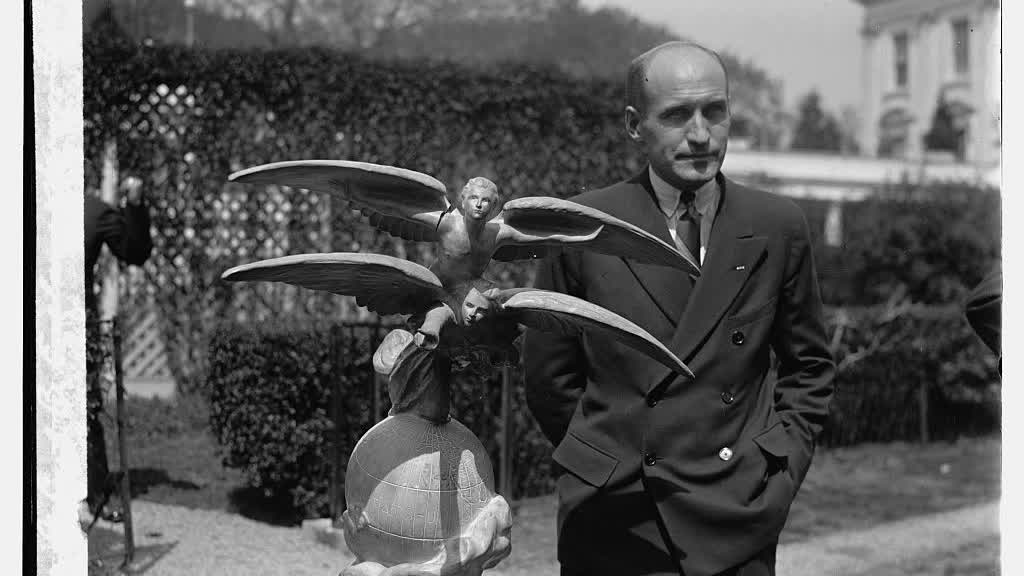
The following year, the United States awarded Eielson the Distinguished Flying Cross. President Herbert Hoover presented him with the Harmon Trophy for 1928 on the White House lawn.
South: a map that needed correction
Eielson and Wilkins did not stop at the Arctic. In November 1928, from a rough strip on Deception Island, they made the first powered airplane flight in Antarctica. In late December, they flew for roughly ten hours along the Antarctic Peninsula, seeing in one day terrain that would have taken a ground party months to approach. A modern Australian Antarctic Program history dates the flight to December 20 and rounds it to 11 hours; a contemporaneous Nature report gives December 19 and nine hours. The difference does not change what the flight demonstrated.
The flight demonstrated what aerial reconnaissance could do. It also demonstrated its limits.
From above, Wilkins interpreted low, ice-filled features as straits dividing Graham Land into islands. A later British expedition traveled the ground and found glaciers instead. The supposed channels were removed from the map. Eielson’s job was flying rather than chart interpretation, but the correction belongs in the story: daring could open a new view without making every conclusion from that view correct.
By the end of 1928, Eielson and Wilkins had flown in both polar regions in a single calendar year. Eielson was 31.
The mission that did not come back
Fame did not satisfy the plan Eielson had carried since his first Alaska mail run. He wanted an aviation network, not a life made only of record flights. In 1929, he returned north as vice president and general manager of the newly organized Alaskan Airways.
That autumn, the trading ship Nanuk became trapped in ice near North Cape on the Siberian coast. It carried passengers and a valuable fur cargo. Eielson’s company accepted a contract to fly people and freight out. On an initial trip, Eielson and mechanic Earl Borland helped bring six passengers and part of the cargo to Alaska.
On November 9, they left Teller for another flight to the ship. Another pilot turned back when he met heavy fog over the Bering Strait. Eielson and Borland did not return.
The search expanded across borders and deepened into winter. Wreckage was found on the Siberian coast on January 25, 1930; Borland’s remains were recovered in February, then Eielson’s. Some later accounts blamed a faulty altimeter found indicating an altitude above the ground. The surviving evidence does not establish the final sequence with certainty. Weather was poor, nobody witnessed the crash and both men were killed.
Eielson’s body came home by ship and train. In March 1930, North Dakota buried him at Hatton with military honors. He was 32.
What the firsts can hide
“Father of Alaska aviation” became Eielson’s memorial title, and an Air Force base outside Fairbanks has carried his name since 1948. The nickname should not erase the other pilots, mechanics, investors, postal workers and local residents who built Alaska’s aviation system. Nor should old claims that airplanes brought “civilization” go unchallenged; communities were there before the runways.
Eielson’s real distinction does not need those myths. He is one of the lives collected in our sourced guide to famous people from North Dakota, where every connection is labeled rather than assumed.
He recognized early that northern aviation would matter most when it stopped being a spectacle. A mailbag reaching McGrath, a doctor reaching a camp and a passenger leaving an icebound ship were, to him, versions of the same argument: an airplane could make isolation less absolute.
The last mission ended in the same weather and distance he had spent his career trying to overcome. That is the hard edge of his legacy. He made the North smaller, but never safe.
Follow Eielson’s North Dakota trail
- Hatton-Eielson Museum: Eielson’s childhood home at 405 Eielson Street holds family furnishings, local history and aviation material. A separate hangar one block away displays the Fokker “Alaskan,” an airplane associated with his earlier polar-expedition work, not the Lockheed Vega used for the 1928 trans-Arctic crossing. North Dakota Tourism lists seasonal, appointment-only access and the phone number 701-543-4097. The museum’s own website did not respond during our September 8, 2026 check. Arrange the visit directly before driving, especially now that the summer season has ended.
- North Dakota State Capitol, Bismarck: Eielson received the Theodore Roosevelt Rough Rider Award posthumously in 1997. His portrait is part of the Rough Rider Hall of Fame on the Capitol’s lower level. The state offers weekday tours year-round, with seasonal additions; check the official schedule for current entry instructions.
Frequently asked questions
Who was Carl Ben Eielson?
Carl Ben Eielson was a pilot born in Hatton, North Dakota, in 1897. He flew Alaska’s first official experimental airmail route, piloted the first trans-Arctic airplane flight and took part in the first powered flights in Antarctica.
Did Carl Ben Eielson fly over the North Pole?
No. Eielson and Hubert Wilkins crossed the Arctic Ocean from Point Barrow to Svalbard in 1928, but their course did not pass over the geographic North Pole. “First trans-Arctic flight” is the accurate description.
How did Carl Ben Eielson die?
Eielson and mechanic Earl Borland died when their aircraft crashed on the Siberian coast on November 9, 1929. They were flying toward the icebound ship Nanuk to continue removing passengers and cargo. The precise cause was never established conclusively.
Where can you see one of Eielson’s airplanes?
The Hatton-Eielson Museum’s separate downtown hangar displays the Fokker “Alaskan,” which Eielson flew in polar-expedition work. It is not the Lockheed Vega used for the record 1928 crossing.
Source notes
Congressional Record, March 25, 1930, pp. 6069–6075. Its Air Corps and Commerce chronology controls Eielson’s birth, UND degree, military training, federal work and awards. The accompanying Fargo Forum profile is treated as recollection.
Federal Aviation Administration, Civil Aviation Policy in Alaska, 1913–2018, pp. 8–9, 16. This institutional history documents the Farthest North company, the 1923 Jenny, commercial flying, the 1924 mail experiment, its safety problems and Eielson’s later inspector role.
National Park Service, Dichinanek’ Hwt’ana: A History of the People of the Upper Kuskokwim Who Live in Nikolai and Telida, Alaska, pp. 58–59. This source supplies exact first-mail-flight times and places that flight within the transportation history and remembered experience of Upper Kuskokwim communities.
National Postal Museum, “Ben Eielson, the ‘Father of Alaska’s Airmail Service’”. Smithsonian context for the experimental route, its cancellation and the Wilkins partnership.
Nature, “News and Views,” April 28, 1928, and the National Film and Sound Archive of Australia, “Northward Bound!”. These sources control the route, distance, conditions, navigation and crucial fact that the course did not cross the geographic North Pole.
Australian Antarctic Program, “Opening up the Antarctic skies”, and Nature reports from January 1929 and December 1936. These distinguish the first short Antarctic flight from the later survey, disclose the date-and-duration discrepancy, and document the subsequent correction of Wilkins’s supposed straits.
University of Alaska, “Carl ‘Ben’ Eielson”, and the National Park Service’s Carl Ben Eielson House National Register nomination. These support the Nanuk chronology, return to Hatton and memorial history. Where they differ on causation, the article states the uncertainty.
Current visitor references: Hatton-Eielson Museum, its tour page, the North Dakota governor’s Eielson biography, the Rough Rider Hall of Fame directory and the Capitol tour schedule.
Full historical check: August 7, 2026. A September 8 partial visitor check replaced the summer-hours summary with the current tourism listing’s appointment guidance and reconfirmed weekday Capitol tours. Spot an error? Read our editorial standards and corrections policy.