The North Dakota Pretzel That Outgrew Its Hometown
Dorothy “Dot” Henke turned a seasoned snack from a rural Velva kitchen into a national brand. The true story is better than the billion-dollar shorthand. It is also more complicated.
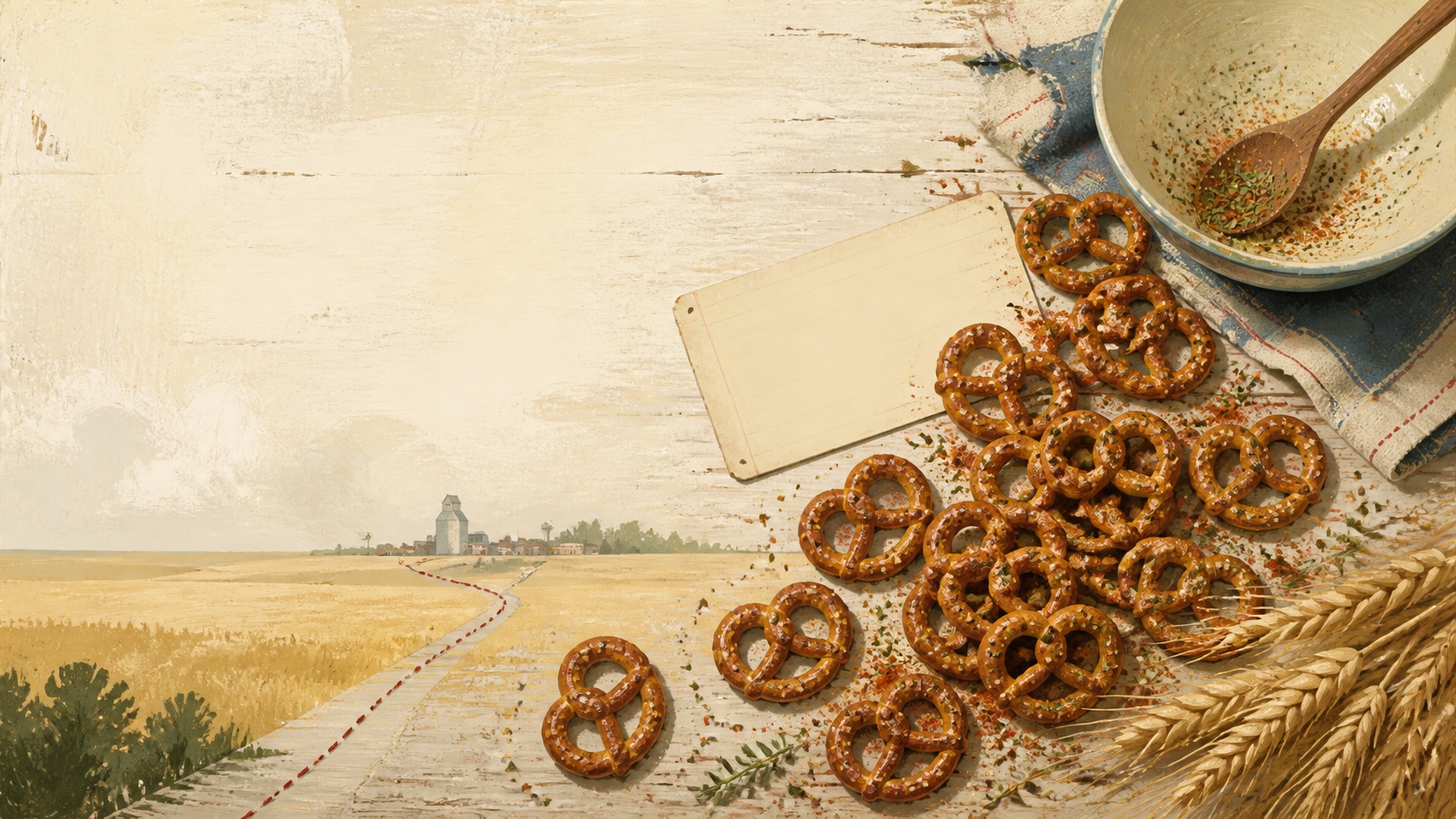
A bag of Dot’s looks like a finished idea: the red seal, the name, the familiar twists carrying seasoning into every groove. The business behind that bag did not begin that way. It began with ordinary pretzels, a recipe that kept changing and a founder who had planned to retire.
By Christmas 2011, Dorothy “Dot” Henke was packaging her seasoned pretzels as gifts. In 2012, she tested them at a Pride of Dakota showcase. Before the decade was over, workers in three states were making them, stores across the country were carrying them, and a small city near Minot had become the birthplace of a national snack.
Then came the figure that swallowed every other part of the story: $1.2 billion.
That number was real, but it did not mean what countless headlines and retellings made it sound like it meant. Hershey’s purchase covered two companies, not simply Dot’s Pretzels, and the amount paid for Dot’s was not the same as the amount received by Dorothy Henke. The ownership details of the private company were not publicly disclosed.
The better story is not about stumbling into a billion dollars. It is about recognizing a signal, building a system around it and discovering what happens when a hometown product grows beyond the hometown that made it possible.
The first useful objection
Henke’s starting point was not a laboratory or a formal product-development meeting. In interviews, she traced the idea to a homemade snack mix she tried at a wedding reception in Max, North Dakota. She liked the buttery pretzel pieces, but found the mixture too hot. Back in her rural Velva kitchen, she began adjusting seasonings and making a version that suited her own household.
This matters because the product was not presented to the world as a technical invention. Seasoned pretzels already existed. Henke’s work was in the particulars: which pretzel, which coating, which balance of flavors and which second bake produced a snack people wanted to keep eating.
She had learned to cook without treating recipes as sacred texts. Henke told reporters that her mother cooked for large family gatherings with a “pinch of this” approach. Henke, who grew up on a North Dakota dairy farm and later worked for about 30 years as a financial assistant, carried that habit into the experiments that became Dot’s.
The recipe’s first serious test arrived disguised as a favor. During the 2011 Christmas season, a family member in Arizona wanted simple gifts for clients. Henke packed the pretzels into small bags and finished them with red bows. According to Henke’s account in a North Dakota Department of Agriculture publication, the recipients began calling to ask where they could buy more.
There are two places in this origin story, and they are sometimes blurred together. Henke developed the snack in the Velva area; Arizona supplied early gift recipients and a flag-football concession stand where people paid for it. The business that followed was based in Velva. Saying only “an Arizona snack” misses the North Dakota kitchen, company and workforce. Saying the entire proof of concept happened in Velva misses the customers who helped turn a family recipe into evidence.
The table where strangers told the truth
Friends and relatives are unreliable market research. They may love the food. They may also love the person who made it.
Henke later said she wondered whether the gift recipients had simply been polite. A public showcase offered a cleaner test. In May 2012, she took samples to a Pride of Dakota event in Williston, part of the state Department of Agriculture’s program for North Dakota products and businesses.
People could walk past. Instead, they tasted and bought.
That distinction became the early sales strategy. Dot’s did not begin with a national advertising campaign. It put the product into people’s hands. Henke sent samples to prospective retailers and followed up by telephone. The North Dakota agriculture publication describes Pride of Dakota as her frequent source for practical questions; Henke said the program either had an answer or helped her find one.
The path from tasting table to store shelf was improvised. Henke and her husband, Randy, used a commercial kitchen connected to a Velva grocery store. They later bought and refurbished a worn building, opening the first dedicated Velva plant in November 2012. For roughly two and a half years, workers still weighed and filled the bags by hand.
Even distribution had a homemade phase. Henke recalled loading her car and meeting a distributor near the junction of US Highway 83 and North Dakota Highway 23 to transfer pretzels into his vehicle. A nephew helped place the snack in a Minnesota convenience store. Cenex stations became early outlets. Hardware and farm stores (places with loyal traffic but no obligation to behave like supermarkets) proved unusually important.
An Ace Hardware connection helped the brand move through that network. By 2019, True Value stores were another national channel. The result looked like word of mouth because customers recommended the product to other customers, but word of mouth alone cannot stock shelves. Behind it were phone calls, samples, packaging work, distributor relationships and repeated follow-up.
When a recipe becomes an employer
The company’s growth was also a Velva story.
Randy Henke was Dorothy’s partner in the business. Family connections helped find early outlets, and state showcase staff helped the founders navigate unfamiliar problems. As orders grew, however, the work could not stay inside a family circle. The company needed plant managers, food-safety systems, accounting, customer service, marketing and a dependable supply of base pretzels.
In September 2019, KFYR reported that more than 60 people worked four days a week at the Velva plant. A Forum News Service report three months later put employment there above 70, up from about 25 a little more than a year earlier. Those reports are snapshots, not permanent totals, but they show the speed of change in a city of roughly a thousand people.
The original building was no longer enough. Dot’s acquired another nearby structure, and manufacturing spread well beyond North Dakota. A Goodyear, Arizona, operation followed; Hershey’s current plant history says it opened in 2016 with fewer than 12 employees. A Lenexa, Kansas, facility began producing Dot’s in 2017, placing capacity closer to a large transportation network.
In 2018, the company partnered with Fargo-based R.D. Offutt Company. Randy Henke described the need plainly in a later public appearance: Dot’s needed more expertise, market leverage and capital to solve supply problems and keep expanding. Public accounts call the relationship a partnership and identify R.D. Offutt leaders in Dot’s management, but they do not disclose the private transaction’s complete ownership or financial terms.
By October 2019, the Henkes said more than 200 employees were making and selling almost 1.6 billion individual pretzels. In mid-2020, Forbes reported employment above 400 across three states. The figures came from different moments during rapid hiring, which is why they should not be treated as directly comparable annual statistics.
Capacity remained the constraint. In June 2020, the Kansas Department of Commerce announced a planned $15 million Dot’s facility at Logistics Park Kansas City in Edgerton, with 22 new jobs. The 186,000-square-foot plant opened that November. Automation there allowed far greater throughput than the first hand-filled bags in Velva.
The expansion was not a rejection of the hometown method. It was the consequence of its success.
What Hershey actually bought
On November 10, 2021, The Hershey Company announced agreements to acquire Dot’s Pretzels LLC and a second business, Pretzels Inc. Pretzels Inc. was already a co-manufacturer for Dot’s and operated plants in Indiana and Kansas. Buying both would give Hershey the consumer brand and more of the manufacturing expertise and capacity behind it.
The combined announced price was approximately $1.2 billion. Hershey said the two businesses had generated about $275 million in estimated aggregate net sales during the 12 months ending in September 2021. It also said Dot’s had accounted for 55 percent of the pretzel category’s growth during the preceding year, using the company’s market definition and cited retail data.
The transactions closed on consecutive days that December. After final measurement-period adjustments, Hershey’s 2022 annual report recorded cash consideration of approximately $891.2 million for Dot’s and $304.3 million for Pretzels Inc. The latter was a separate manufacturer, not another name for Dorothy Henke’s brand.
That is why “Dot sold her pretzels for $1.2 billion” is a bad sentence. It assigns the combined price to one acquisition and suggests the entire sum went to one person. The filings do not show how Dot’s proceeds were divided among its private owners, how much each owner held, or each seller’s taxes and transaction costs. The public record supports an extraordinary value for the company. It does not support guessing at Henke’s personal proceeds.
The acquisition was still a remarkable outcome. Less than ten years separated red-bow gift bags from a transaction in which Hershey valued Dot’s alone at nearly $900 million.
The part of the success story that hurt
A familiar founder story could end at the sale. Velva’s did not.
In August 2023, Hershey announced that it would close the original Dot’s facility on October 27. The company said the building’s physical limits and operating costs made it difficult to scale, and that the plant accounted for a small share of total production. Twenty-seven employees were affected and were offered relocation opportunities or severance arrangements, according to the company statement reported by Forum News Service.
For Hershey, production could move through a larger network. For Velva, the closure meant the loss of jobs and the factory that had connected a national bag to a specific corner of town. Both facts belong in the history. The brand’s growth created real local employment; its later consolidation removed it.
The official Hershey plant directory now identifies Dot’s production at facilities including Goodyear and Lenexa, the Edgerton plant that can make all listed flavors, and plants in Lawrence, Kansas, and Bluffton and Plymouth, Indiana, that bake or produce Dot’s items. It does not list a North Dakota plant.
That does not make “born in Velva” false. It makes “made in Velva” historical.
Where Dot’s stands now
As of August 7, 2026, Dot’s remains an active Hershey brand in the company’s U.S. snack portfolio. Hershey’s consumer site lists Original, Parmesan Garlic, Honey Mustard, Cinnamon Sugar, BBQ, Buffalo and Southwest seasoned twists, along with an Original snack mix introduced nationally in 2026.
The brand has not been disappearing inside its parent company. Hershey reported that Dot’s reached the number-one share position in its defined U.S. pretzel market during the third quarter of 2025. In the fourth quarter, the company said Dot’s retail sales grew more than 20 percent from the same period a year earlier. Its latest quarterly filing, covering the quarter ended June 28, 2026, said Dot’s was the primary driver of roughly 4 percent volume growth in North America Salty Snacks, although the accompanying earnings release also noted execution problems involving multipacks and Dot’s pretzels.
Those are Hershey’s market reports, not an independent audit of affection. Hershey does not publicly break out Dot’s revenue as a standalone line. The brand’s seasoning remains described as a trade secret, and no reliable public evidence establishes the internet’s recurring claims that a particular ingredient or the full recipe changed after the acquisition.
What can be said is stronger than a rumor: a product developed near Velva became a leading national pretzel brand, even after its North Dakota plant closed.
The useful lesson in a runaway snack
It is tempting to explain Dot’s with one magical ingredient. The available history points to a less magical and more demanding combination.
Henke changed a snack until it pleased her. Gift recipients supplied the first unsolicited demand. Pride of Dakota shoppers provided a test among strangers. Sampling solved the problem of selling an ordinary-looking pretzel at a premium. Unconventional retailers provided shelves. Family, state staff, local workers, distributors and outside partners supplied capabilities the original kitchen did not have. New plants relieved one bottleneck and created the next scale of business.
The ending is complicated because scale is complicated. Dot’s gave Velva a national claim and dozens of jobs, then outgrew the physical place where those jobs began. Hershey acquired the origin story, the trademark, customer relationships and a fast-growing product, but the company could not acquire the years in which a founder drove bags to a highway handoff or workers weighed each one by hand.
The brand moved on. The beginning stayed in North Dakota.
Dot Henke is also part of our sourced guide to North Dakotans whose work traveled outward, where birthplace, upbringing and later state ties are labeled rather than blurred together.
Frequently asked questions
Who founded Dot’s Pretzels?
Dorothy “Dot” Henke founded the company with her husband and business partner, Randy Henke. Dorothy developed the seasoned pretzel recipe in the Velva area and began selling it in 2012.
Where did Dot’s Pretzels start?
The recipe and company originated around Velva, North Dakota. Arizona was also important: gift recipients and concession customers there provided some of the earliest evidence that strangers would seek out and pay for the pretzels.
Who owns Dot’s Pretzels today?
The Hershey Company owns Dot’s. Hershey completed its acquisition of Dot’s Pretzels LLC on December 13, 2021, and reports the brand within its U.S. snacks business.
Did Hershey pay $1.2 billion for Dot’s Pretzels?
Not for Dot’s alone. Approximately $1.2 billion was the combined price for Dot’s Pretzels and Pretzels Inc., a separate manufacturer. After final measurement-period adjustments, Hershey’s 2022 annual report recorded cash consideration of about $891.2 million for Dot’s and about $304.3 million for Pretzels Inc.
Are Dot’s Pretzels still made in North Dakota?
No current North Dakota production facility appears in Hershey’s official plant directory. Hershey closed the original Velva plant in October 2023 and shifted its production to the company’s larger manufacturing network.
Source notes
North Dakota Department of Agriculture, North Dakota Agriculture 2023, p. 16. This first-person state publication controls the Christmas 2011 gift account, red bows, the Williston Pride of Dakota test and Henke’s description of the program’s help.
Christopher Vondracek, Forum News Service, “Why there’s no stop in North Dakota’s pretzel queen ‘Dot’ Henke”, December 20, 2019. This interview supplies Henke’s recipe inspiration, work background, Velva employment snapshot and early production context.
Helmut Schmidt, Forum News Service, “‘Dot’ of Dot’s Pretzels shares snack-tastic success story”, October 23, 2019. This report covers a public presentation by Dorothy and Randy Henke and supplies the November 2012 plant opening, hand-bagging period, factory timeline, approximate employee and pretzel counts, and R.D. Offutt partnership account.
Rachel Hutton, Star Tribune, “How Dot’s Pretzels became the Midwest’s new food phenom”, November 24, 2018. This reported profile documents the early car-to-distributor handoffs, retail sampling, Cenex response, family connections and hardware-store distribution.
Megan Hoffman, KFYR-TV, “Dot’s Homestyle Pretzels expanding with new products”, September 18, 2019. This local report supplies the dated Velva workforce and expansion snapshot.
Kansas Department of Commerce, “Dot’s Pretzels, LLC”, June 10, 2020, and Packaging World, “Robotic Automation … Doubles Capacity for Dot’s Pretzels”, December 2022. These sources document the planned $15 million Edgerton investment, 22 new jobs, plant size, opening and later automation.
The Hershey Company’s acquisition announcement, dated November 10, 2021, and completion announcement, dated December 14, 2021. These are the controlling sources for the two-company structure, combined $1.2 billion announced price, estimated aggregate sales and contemporaneous market-growth claim.
The Hershey Company, 2022 Form 10-K, Note 2. This SEC filing controls the closing dates and cash consideration after final measurement-period adjustments: $891.169 million for Dot’s and $304.334 million for Pretzels Inc.
Tammy Swift, Forum News Service, “Hershey’s plans to close Dot’s Pretzels flagship facility in Velva”, August 22, 2023. This report quotes Hershey on the reason for closing and documents the 27 affected employees and October 27 closure date.
The Hershey Company, official plant directory. This current company page identifies the plants and Dot’s products made at Goodyear, Lenexa, Edgerton, Lawrence, Bluffton and Plymouth.
The Hershey Company’s third-quarter 2025 results, fourth-quarter 2025 results and Form 10-Q for the quarter ended June 28, 2026. These filings support the dated number-one-share, retail-growth and current volume statements.
Hersheyland’s Dot’s brand and product pages and The Hershey Company’s March 10, 2026 snack-mix release. These sources document current ownership, listed flavors and snack-mix launch; product availability can change.
Full company check: August 7, 2026. A September 8 partial check confirmed the acquisition accounting, current plant directory and second-quarter 2026 volume statement, and corrected US Highway 83’s designation. Spot an error? Read our editorial standards and corrections policy.