Before Peggy Lee, There Was Norma Egstrom
A short-line depot, small radio studios and one well-timed new name shaped the North Dakota years of an American original. They did not make her legend inevitable.
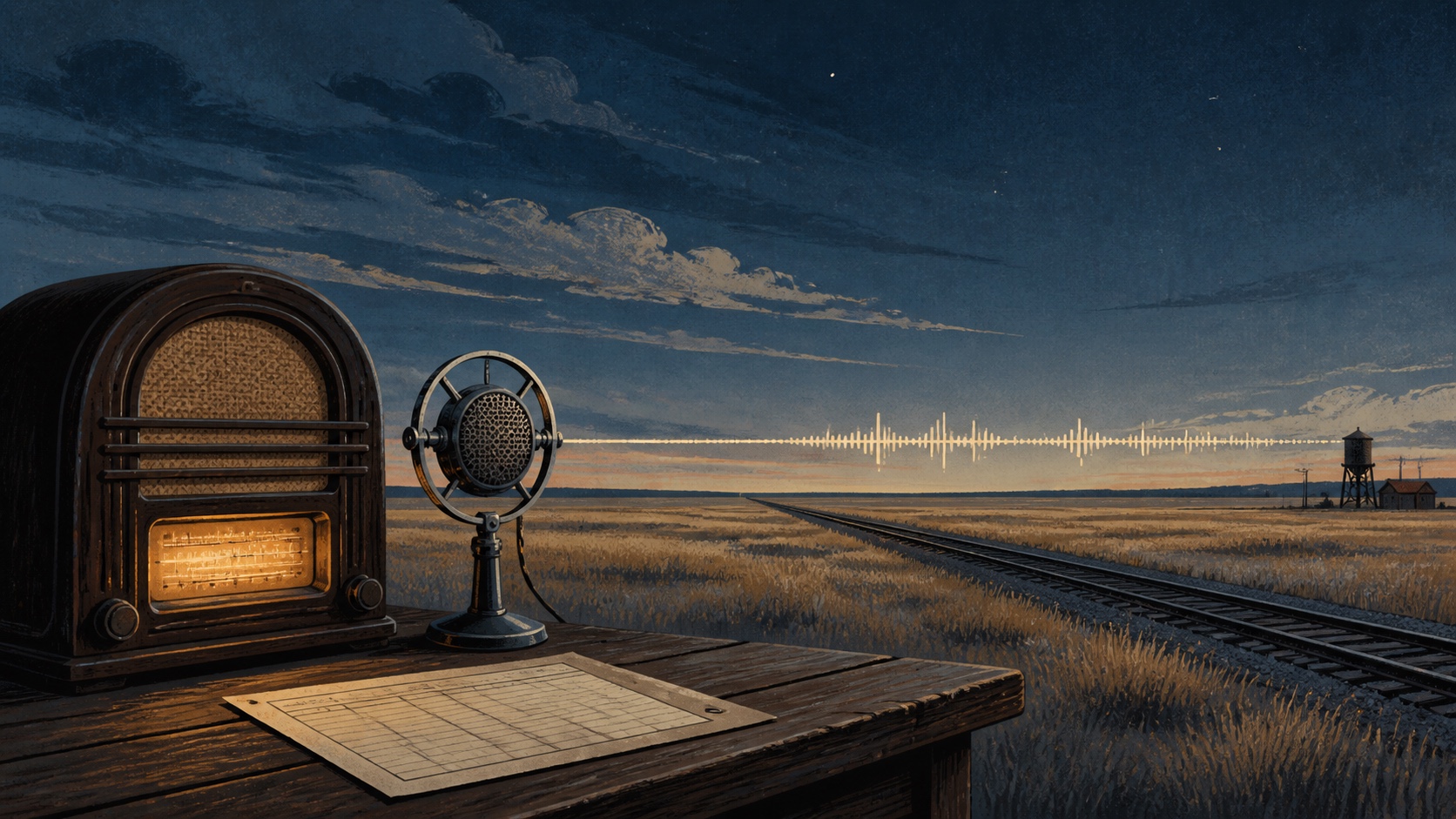
Climb the stairs inside the old Midland Continental depot in Wimbledon and two histories meet.
Downstairs are the working rooms of a railroad once imagined as a route from Canada to the Gulf of Mexico. Only 77 miles were built. Upstairs are the rooms where the depot agent’s family lived, and where a teenager named Norma Deloris Egstrom spent her last high-school years. The museum now displays Peggy Lee dresses, photographs and memorabilia there. Visitors can listen to the voice that traveled much farther than the railroad ever did.
The distance between those rooms and national stardom makes an irresistible fable: prairie girl escapes hardship, changes her name and conquers America. The documented story is more interesting. North Dakota supplied Lee’s first audiences, working knowledge of radio and the professional name she kept for the rest of her life. Her famous soft-volume method was refined later in California. Benny Goodman found her in Chicago. What followed required choices, collaborators, discipline and artistic control that no birthplace can explain for her.
Before all of it, though, came a family moving station by station along a very small railroad.
A childhood measured in depot stops
Norma Deloris Egstrom was born in Jamestown on May 26, 1920. Her father, Marvin Egstrom, worked for the Midland Continental Railroad. Company records summarized in the Wimbledon depot’s National Register nomination trace his assignments from Jamestown to Nortonville in 1928 and to Wimbledon in 1934.
The route was not gentle. Norma’s mother, Selma, died in 1924. A fire destroyed the Nortonville depot in January 1930, taking the family’s possessions with it. Lee later described physical and emotional abuse by her stepmother in her autobiography and interviews. That part of the childhood story comes principally through Lee’s own testimony; it should be identified as her account, not rebuilt with invented dialogue or scenes.
From 1934 until her 1937 graduation, Norma lived above the Wimbledon depot. In her autobiography she recalled doing real railroad work when her father could not: preparing car-movement reports and waybills, sealing freight cars and relaying telephone messages. The National Register historian found the duties plausible within the railroad record, but the detailed memories remain hers.
One piece of the teenage paper trail is unusually vivid. In April 1937, after a college student mocked an uncomfortable caboose ride, Norma wrote to the Valley City State student newspaper to defend the Midland. She reminded readers that the little line had moved sick people and supplies when winter storms cut towns off. Years before she wrote songs for Hollywood, she was already willing to argue in print for the overlooked operation that employed her family.
It is tempting to draw a straight line from waybills to show-business command. The evidence cannot do that. It can establish something less romantic and more useful: before fame, Norma understood that work happened behind the public-facing moment.
The radio on both sides of the microphone
Radio made distance porous. Lee later remembered discovering the Bennie Moten orchestra, with Count Basie, through a five-dial Atwater Kent set. She did not describe the sound as a genre lesson. To her young ear, it was simply good music arriving from far away.
By her mid-teens she was sending music the other direction. She sang with Doc Haines’s college dance band and appeared on KOVC in Valley City. The current Peggy Lee estate biography places her weekly, 15-minute Norma Egstrom Show there when she was 16. That was not yet a national break. It was something more practical: repeated experience choosing material, facing a microphone and holding an unseen audience.
Fargo offered a stronger signal. At 17, she auditioned at WDAY, then North Dakota’s most powerful station. Program director Ken Kennedy hired her and supplied the stage name Peggy Lee. Later versions decorate the moment with different dialogue, but the central fact is consistent across Lee’s recollections, the estate and North Dakota records: Kennedy named her.
The next year does not fit a tidy discovery story. Evidence points to two WDAY periods around an unsuccessful 1938 California trip. She tried the West Coast while still a teenager, returned to Fargo and resumed the kind of work that paid in experience more reliably than glamour. WDAY’s own 1939 promotional book lists Peggy Lee with its staff orchestra.
In Fargo she sang on variety programs, played a comic character in radio sketches and helped file music. Lee later said that the filing introduced her to the work of Jerome Kern, Cole Porter, Rodgers and Hart, George Gershwin, Johnny Mercer and Harold Arlen. She also recalled a night job slicing bread at a bakery, followed by preparation for a noon broadcast. The story is not that WDAY instantly made her famous. It made her useful in several kinds of live radio.
The physical setting survives, although the studio does not survive as a visitor attraction. WDAY operated from Fargo’s Art Moderne Black Building. Its lease required an on-air identification linking the station to the building, according to the property’s National Register nomination. Today the upper floors are private residential and professional space. From the public sidewalk, the limestone tower remains a marker of the city where Norma Egstrom became Peggy Lee. It is not a museum with an open historic studio.
The breakthrough happened elsewhere
After Fargo came Minneapolis, regional bands and another trip west. In early 1941, Lee was singing at the Doll House in Palm Springs when, as she later told the story, she stopped trying to overpower a noisy room and sang more quietly. The audience quieted to hear her. Whether every beat of that often-repeated memory can be verified or not, Lee consistently identified California, not the silence of a North Dakota prairie, as the place where she recognized the power of singing softly.
That distinction matters. North Dakota gave her microphone time; it does not get automatic credit for every element of the mature sound.
A Chicago engagement followed. Benny Goodman heard Lee at the Buttery Room and hired her in 1941. With his orchestra, she moved onto a national stage and recorded the 1942 hit “Why Don’t You Do Right?” She met guitarist Dave Barbour in the band. They married in 1943, and Lee left Goodman with an initial intention to retire.
The retirement did not last. Lee returned to recording for the young Capitol label in late 1944. With Barbour, she co-wrote songs including “I Don’t Know Enough About You” and “It’s a Good Day.” Her career kept expanding: recording artist, songwriter, arranger, radio host, television performer, actor and exacting architect of her own stage presentation.
That range is easy to miss if the story is reduced to a few famous recordings. “Fever” displayed how completely she could remake material through timing and restraint. The cool, unsettling “Is That All There Is?” earned her only competitive Grammy. Yet interpretation was only one part of the work. The estate credits Lee with writing more than 270 songs; the Songwriters Hall of Fame inducted her in 1999.
For Disney’s 1955 Lady and the Tramp, Lee worked with Sonny Burke on the original songs and voiced four characters: Darling, Peg, Si and Am. Her performance in Pete Kelly’s Blues brought a Best Supporting Actress nomination at the 1956 Academy Awards. Decades later, she fought Disney over home-video use of her work; a California appellate court upheld a $3 million judgment in 1992. The episode made visible what had long been true: Lee regarded her voice and writing as authored work, not decoration owned by whoever recorded it.
Her name even slipped into another corner of popular culture. Muppet designer Bonnie Erickson told Smithsonian that she first called the puppet “Miss Piggy Lee,” both a joke and an homage. The surname was dropped as the character grew more famous. Erickson added a North Dakota footnote: her mother had lived in the state when Lee sang on local radio.
The name she never discarded
North Dakota honored Lee with the Theodore Roosevelt Rough Rider Award on May 23, 1975. By then she had been nationally known for more than three decades. The honor did not reclaim a star who had hidden her origin. She had already made the connection impossible to miss.
Her final original Capitol album, released in 1972, carried an extraordinary title: Norma Deloris Egstrom from Jamestown, North Dakota.
That title complicates the old transformation myth. Ken Kennedy’s new name worked brilliantly, but Peggy Lee did not have to erase Norma Egstrom to sustain it. She placed the birth name and hometown across a late-career album, after the hits, films, tours and television appearances had made “Peggy Lee” instantly recognizable.
The two names held different kinds of truth. Norma was the girl who lived above a depot, defended a railroad, sang into local microphones and returned home after an early California failure. Peggy was the professional identity under which she built one of American popular music’s most distinctive bodies of work. They were not before-and-after photographs. They were the same artist, carrying the earlier name inside the later one.
That is what the Wimbledon depot preserves. Not proof that a North Dakota childhood inevitably produced a legend. Proof that the legend began as work done in particular rooms, for particular small audiences, before most of the country knew to listen.
Visit Peggy Lee’s North Dakota
The stops below connect to Lee’s documented history. A September 8, 2026 partial visitor check reconfirmed the Wimbledon museum’s appointment-only access and free admission through North Dakota Tourism, and weekday Capitol tours through the state. Other visitor details retain their August 7 check date; contact small museums before traveling.
Midland Continental Depot Transportation Museum, Wimbledon
The restored depot at 401 Railway Street includes railroad exhibits downstairs and Peggy Lee’s former living quarters and exhibits upstairs. It is open year-round by appointment; admission is free and donations are welcomed. Call 701-320-1020. The building has an accessible bathroom, but the second floor is reached only by stairs and has no elevator.
Peggy Lee mural, Valley City
Bill Cochran’s mural is on the north side of the historic Rudolf Hotel building at 151 Central Avenue South, the former KOVC location associated with Lee’s early radio work. It is an outdoor public-viewing stop, not a museum exhibit.
The Black Building, Fargo
See the historic WDAY building at 114–118 Broadway North from the public sidewalk. It is a mixed-use private building, and no preserved Peggy Lee studio or public tour is verified. Pair it with a walk through downtown Fargo, not an attempt to enter private upper floors.
Rough Rider portrait, Bismarck
Lee’s portrait by Emmett Morgan hangs with other Rough Rider Award recipients in the lower level of the North Dakota State Capitol, 600 East Boulevard Avenue. Use the south public entrance and ask at the information desk. Weekday guided tours run year-round; generally there are no weekend or holiday guided tours outside the summer program. Check the state’s schedule for your date.
Lee’s route from Jamestown through Wimbledon, Valley City and Fargo is one of the state’s better-known lives and real connections. The Fargo-to-Medora guide can also help place the eastern stops inside a realistic I-94 crossing.
Frequently asked questions
Where was Peggy Lee born and raised?
She was born Norma Deloris Egstrom in Jamestown on May 26, 1920. Her father’s railroad assignments took the family to Nortonville in 1928 and Wimbledon in 1934. She lived in the Wimbledon depot until graduating in 1937.
How did Norma Egstrom become Peggy Lee?
WDAY program director Ken Kennedy gave her the stage name when she auditioned at the Fargo radio station as a teenager. The exact dialogue varies among later retellings, so the name (not a polished movie-scene quotation) is the reliable fact.
Did Peggy Lee develop her quiet singing style in North Dakota?
Not according to her own repeated account. North Dakota radio gave her early microphone and repertoire experience. She said the decisive experiment in lowering her volume happened before a noisy audience at the Doll House in Palm Springs in 1941.
Source notes
Peggy Lee Associates’ official biography controls the May 26, 1920 Jamestown birth, Valley City program, WDAY audition and name, 1941 Goodman breakthrough, songwriting scope, Lady and the Tramp work and major honors. Family-count claims conflict elsewhere, so this article gives no sibling ordinal.
Peggy Lee Associates’ liner notes for At Last: The Lost Radio Recordings supply the Valley City–Jamestown–Fargo radio progression, 1937 WDAY naming, sketch character, music-library work and national-radio chronology.
The National Register nomination for the Midland Continental Railroad Depot, especially pp. 13–16, is the main record for Marvin Egstrom’s station assignments, the Nortonville fire, Wimbledon residence, Lee’s memoir-attributed depot duties, her 1937 letter and graduation. The form’s May 27 birth date conflicts with the estate, Governor and NAMM oral-history record; May 26 is used here.
WDAY’s 1939 booklet A Trip Through WDAY, especially pp. 4 and 20, identifies Ken Kennedy as program director and lists Peggy Lee with the WDAY Staff Orchestra, confirming her return after the first California attempt. Cite only; the booklet asserts copyright and its pages are not cleared for reproduction.
North Dakota Studies’ “Radio” history and the Black Building National Register nomination establish local broadcasting context, Lee’s WDAY work, WDAY’s tenancy and the building’s station-identification clause.
The Songwriters Hall of Fame profile, Recording Academy artist record and Recording Academy Lifetime Achievement Awards record support the Goodman/Barbour/Capitol career spine, 1999 Hall induction, 13 Grammy nominations, one competitive win and 1995 Lifetime Achievement Award.
The Academy of Motion Picture Arts and Sciences’ 28th Academy Awards record and the American Film Institute’s Lady and the Tramp catalog entry control the Oscar nomination and four voice roles.
The Los Angeles Times report “$3 Million Award to Peggy Lee Upheld”, published October 6, 1992, supports the narrow lawsuit statement; no claim is made here that one case single-handedly changed entertainment law.
Smithsonian’s October 2008 interview with Muppet designer Bonnie Erickson, “The Woman Behind Miss Piggy”, is the direct source for the “Miss Piggy Lee” account and Erickson’s North Dakota connection.
Peggy Lee Associates’ album record for Norma Deloris Egstrom from Jamestown, North Dakota controls the July 26, 1972 release and status as Lee’s final original Capitol album.
Current visitor information comes from the Midland Continental Depot Transportation Museum and North Dakota Tourism, Valley City Tourism, the North Dakota Governor’s Office and the North Dakota Office of Management and Budget. The museum website had a certificate error when checked September 4, 2026; use the tourism listing or call for access arrangements. Visitor details retain the August 7 check date.
Peggy Lee Associates’ March 19, 2024 article “Peggy Lee Celebrated in Palm Springs” dates the Doll House engagement to early 1941 and identifies the quiet-audience episode as Lee’s account from her 1989 autobiography.
Details last checked August 7, 2026. Spot an error? Read our editorial standards and corrections policy.