Fargo to Medora: The North Dakota Drive That Changes Its Mind
Plan the Fargo-to-Medora drive with realistic timing, the best I-94 stops, four practical route styles, and the time-zone detail travelers miss.
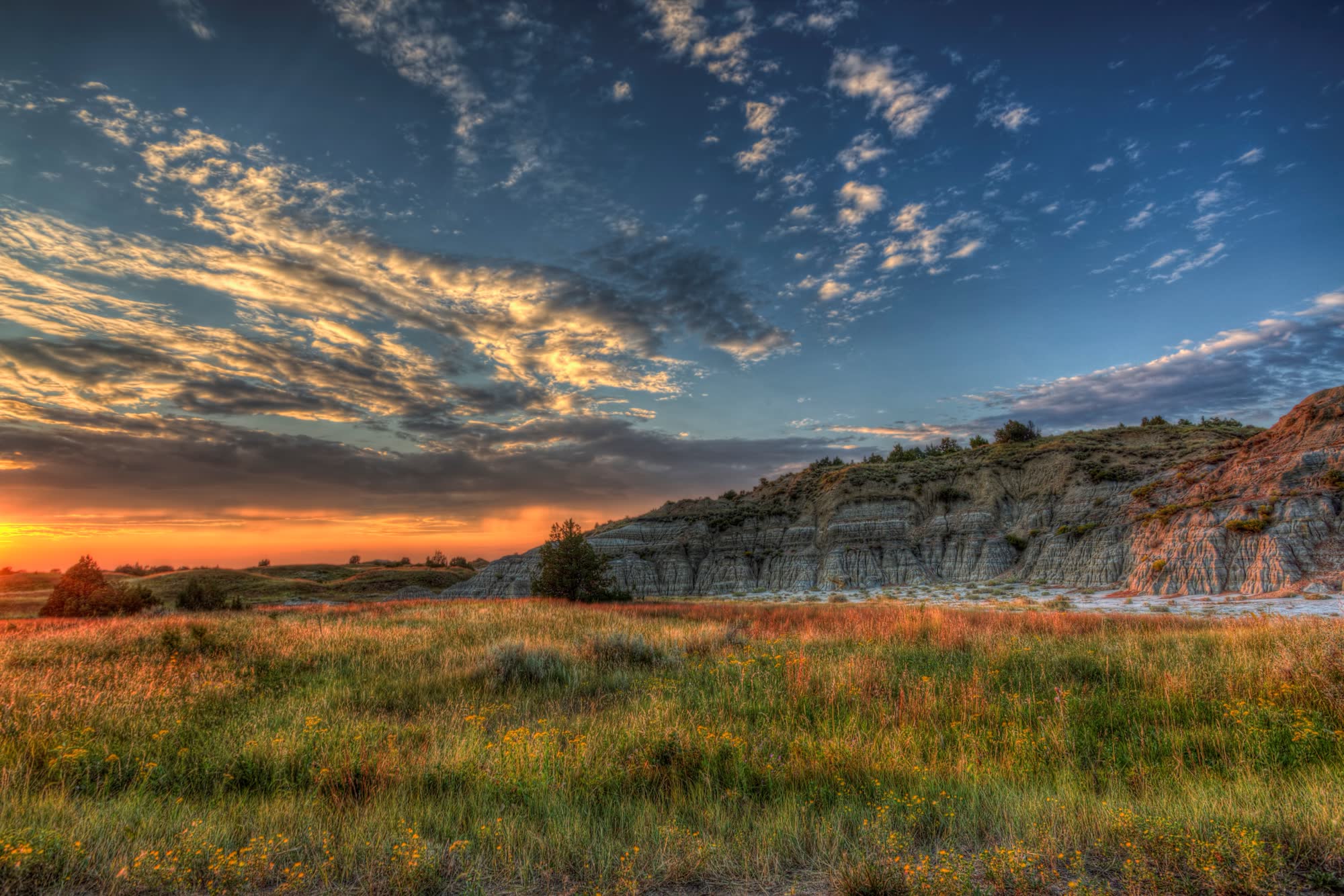
For most of the day, Interstate 94 appears to be telling one story: prairie, sky, grain, distance. Then the ground breaks open.
That last turn is why the 330-mile drive from Fargo to Medora is more than a transfer. The straight-through estimate is about 4½ hours, but a realistic no-attraction day is closer to five hours after fuel, food and ordinary pauses. Choose two meaningful stops and plan on seven to eight hours. Try to collect every giant animal, museum and roadside sculpture on the way, and North Dakota will become a windshield.
The best first crossing is simple: make one substantial stop in Jamestown or Bismarck, one short stop at Salem Sue or Painted Canyon, and save the Theodore Roosevelt Presidential Library and national park for Medora. One more detail matters: Fargo keeps Central Time; Medora keeps Mountain Time. On the westbound trip, the destination clock is one hour earlier.
That is the useful answer. The rest of this guide helps you choose which version of the drive belongs to you.
For routes beyond I-94, start with the statewide things-to-do field guide. If the park is the reason for the trip, decide between the North and South Units before assigning the drive another day.
Traveling as a passenger and wondering about those fields? Open What’s in the field? to compare North Dakota crops by flowers, leaves and seed heads. It gives the highway miles something to notice without adding another stop.
Fargo to Medora at a glance
- Distance: about 330 miles, almost entirely on I-94 west
- Wheel-turning estimate: about 4½ hours in ordinary conditions
- Realistic direct-drive plan: about 5 hours with one fuel/restroom break
- Good sightseeing day: 7–8 hours with two chosen stops
- Time zones: Fargo is on Central Time; Medora is on Mountain Time
- Return to Fargo: budget roughly 5 elapsed hours with ordinary breaks, longer for sightseeing; Fargo's clock is one hour ahead of Medora's
- Road check: use the official ND Roads map or app before leaving
- Best first big stop: North American Bison Discovery Center in Jamestown for families; North Dakota Heritage Center & State Museum in Bismarck for history
- Best quick final stop: Painted Canyon Overlook, Exit 32
- Detour that needs its own time: the full Enchanted Highway adds roughly two hours
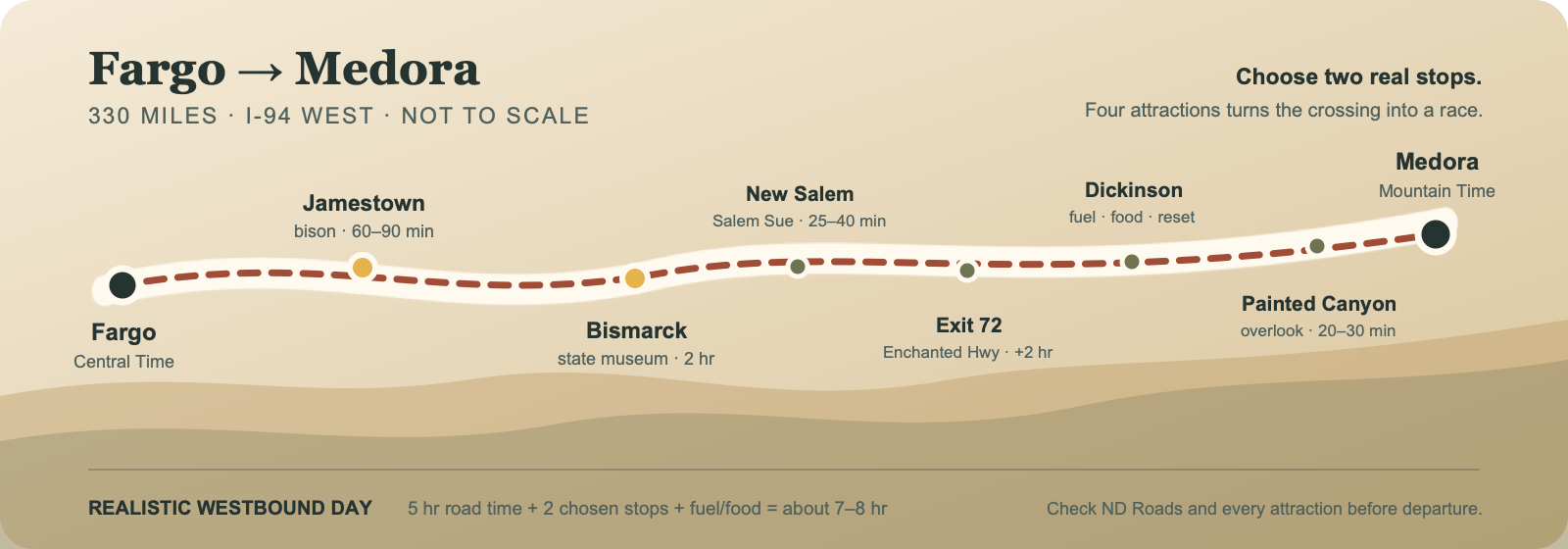
Route schematic by Peace Garden Almanac. Driving and visit times are planning estimates, not promises; check road and attraction conditions before departure.
The rule that saves the drive: choose two stops
North Dakota’s distances invite a particular kind of optimism. Jamestown looks close enough. Bismarck is directly on the route. The enormous cow is free. The metal sculptures are just off the interstate. Painted Canyon is practically mandatory. Each statement is true; the itinerary they create is not.
The stops below are not interchangeable. Jamestown and Bismarck can each hold your attention for hours. Salem Sue is a leg stretch with a view. Painted Canyon is a reveal. The Enchanted Highway is a 64-mile round trip from the interstate before anyone stops to look at anything. Choose stops by purpose, not by quantity.
| Stop | Best for | Sensible allowance | The honest tradeoff |
|---|---|---|---|
| Jamestown | Families, bison, first long break | 60–90 min | A full museum visit can easily run longer |
| Bismarck | State history, fossils, free indoor stop | 90–120 min | Too substantial for a quick walk-through |
| Salem Sue | Roadside Americana, view, stretch | 25–40 min | Weather and hill access affect the experience |
| Enchanted Highway | Folk art, photography, a route within the route | about 2 hr extra | Makes a poor “quick detour” |
| Painted Canyon | First Badlands view, short finale | 20–30 min | Visitor services are seasonal; the overlook is the point |
Stop one: Jamestown, where the prairie acquires a shadow
About 95 miles west of Fargo, Jamestown is the first natural place to stop. The interstate climbs toward Frontier Village, and suddenly a 26-foot concrete bison stands above the valley. The monument is the photo everyone remembers, and the living herd below it is the reason to stay a while longer.
The North American Bison Discovery Center (the current name of the institution long known as the National Buffalo Museum) uses exhibits, a film and rotating displays to explain the animal’s natural history, cultural importance and ecological role. The center also offers seasonal opportunities to see its herds; seeing bison is never guaranteed on a schedule dictated by humans.
This is the strongest family stop because it changes the drive’s subject. Children who have watched fields pass for an hour and a half suddenly have an animal to look for, a giant sculpture to climb toward and a story that will reappear in Theodore Roosevelt National Park.
Do not assume the museum is open every day year-round. Its official hours and admission page, rechecked September 8, 2026, lists September–October hours of 10 a.m.–5 p.m. Monday through Saturday, closed Sunday. If you have only 30 minutes, see the monument and overlook. If the museum is the point, allow at least an hour and confirm the day’s hours.
Choose Jamestown if: you are traveling with children, need an early substantial break, or want the wildlife story to begin before the Badlands.
Keep driving if: your group would rather spend its indoor time with fossils, Indigenous history and statewide artifacts in Bismarck.
Stop two: Bismarck, the museum that can consume the afternoon
The most dangerous phrase in this itinerary is “we’ll just pop into the State Museum.”
The North Dakota Heritage Center & State Museum stands on the Capitol grounds, a short turn off I-94 at Exit 159. Admission is free. Four galleries and hallway exhibits range from deep geological time to contemporary North Dakota. The building holds a life-size T. rex cast, early peoples’ history, machinery, political and social artifacts, and Dakota, the rare hadrosaur specimen with fossilized skin, partly visible in the hall while its body block is shown only on scheduled behind-the-scenes tours. Our children’s story of Dakota the dinomummy explains why the fossil matters.
This is not a gift-shop-and-restroom stop. Even a disciplined sampler needs 90 minutes; two hours is kinder. A family can choose the dinosaur and interactive material. A history reader can move chronologically through the galleries. Anyone who tries to see everything and still arrive in Medora for dinner will learn how fast free museums become expensive in time.
The museum’s official visitor page lists current hours, holiday closures and the free-admission policy. Weekday and weekend opening times differ. The Capitol is next door, but adding a tour means choosing Bismarck as the day’s main event.
Choose Bismarck if: this is your first North Dakota trip, the weather is poor, or your group values history more than roadside novelty.
Keep driving if: you have a fixed ticket time in Medora. A timed commitment and a large museum do not belong in the same optimistic afternoon.
The 38-foot decision at New Salem
West of Bismarck, a white-and-black Holstein appears on a hill as if the landscape has developed a sense of humor.
Salem Sue is 38 feet tall, 50 feet long and has watched I-94 since 1974. The New Salem Lions Club erected her to honor area dairy farmers and their families. That origin makes the stop more than a scale gag: a town turned an agricultural identity into a landmark visible for miles.
The drive up, the photographs and the view generally fit inside 25 to 40 minutes. The hill and local access can be affected by weather; use judgment rather than treating the statue as a scheduled attraction with staffed services. Sue works best as the day’s short stop: the place to stretch, let children run off some distance and look back over the country already crossed.
If you are building a giant-things itinerary, pair her on another day with Jamestown’s concrete bison. If you are trying to reach Medora at a reasonable hour, do not let “one quick photo” become three roadside diversions.
The Enchanted Highway is not an exit-ramp attraction
At Exit 72 near Gladstone, Geese in Flight rises beside the interstate. It is the gateway to the Enchanted Highway, a 32-mile county-road route south to Regent lined with enormous scrap-metal sculptures.
The word “highway” misleads hurried travelers. Driving from I-94 to Regent and back covers roughly 64 miles before time spent at the pullouts. North Dakota Tourism’s route listing sensibly advises against turning around after the first sculptures: most of the works are concentrated farther south. Budget about two extra hours, more if you photograph carefully or stop in Regent.
That makes the Enchanted Highway one of the best experiences between Fargo and Medora, but only when it gets a day of its own; wedged into an already full schedule, it will not get the time it deserves. Treat it as the main stop, perhaps on the return drive. Do not wedge it between a two-hour museum and a timed entry.
Choose the Enchanted Highway if: folk art and photography are the day’s theme, and you can give the route the time it asks for.
Save it for later if: your Medora arrival matters more than completing every pin on a map.
Dickinson: the smart stop before the finish line
Not every good stop needs to become content.
Dickinson is the last substantial service center before Medora and an excellent place to refuel, eat and reset. That makes it valuable precisely because it does not require a museum ticket or narrative. If the tank is low, children are unraveling or weather is building over the west, solve those problems here. The next forty miles deserve attention.
Dickinson also sits in Mountain Time. By this point, verify the clock on any reservation rather than trusting the car display, phone, watch and body to agree at the same moment.
Exit 32: where the drive changes its mind
For hundreds of miles, the land has trained your eye to read horizontal lines. Then, near the western edge of the state, the prairie falls away into buttes, gullies and bands of earth that appear rusted, ash-gray, green and gold depending on weather and light.
Painted Canyon Overlook is reached from I-94 at Exit 32, before Medora. It is the ideal final stop because the drama is immediate: park, walk to the rim and understand where the road has been taking you. Twenty to thirty minutes is enough for the overlook. The Painted Canyon Visitor Center is seasonal, and facilities or trails can close temporarily, so check Theodore Roosevelt National Park conditions rather than building the stop around an open desk.
Wildlife may appear, but this is not a drive-through zoo. Keep distance from bison and other animals, follow posted restrictions, and never stop on an active road for a photograph.
The overlook is also a useful emotional threshold. Jamestown explained bison. Bismarck explained the state. The western edge now removes the ceiling.
Four good ways to make the crossing
1. The no-stress first trip
- Leave Fargo in the morning.
- Spend 90–120 minutes at the State Museum in Bismarck.
- Refuel or eat in Dickinson.
- Stop 20–30 minutes at Painted Canyon.
- Arrive in Medora with enough attention left to check in and walk the town.
This route has one deep stop and one reveal. It is the best default for adults who want context before entering the Badlands.
2. The children’s route
- Make the North American Bison Discovery Center and giant bison in Jamestown the main stop.
- Use Salem Sue as the brief leg-stretch stop.
- Let Painted Canyon be optional, based on energy and daylight.
This keeps the first reward early and avoids asking children to behave inside two large museums on the same day. Our North Dakota-with-kids route turns the full crossing into four westbound days, with the return east needing another travel day. In Medora, leave a separate block for the park’s prairie dog towns and short walks.
3. The roadside-art route
- Drive directly to Exit 72 with only practical breaks.
- Complete the full Enchanted Highway to Regent and return.
- Refuel in Dickinson.
- Stop at Painted Canyon if daylight and weather cooperate.
This version turns the state crossing into a story about scale and self-made landmarks. It also makes a late Fargo departure a poor idea.
4. The history route
- Spend two hours at the North Dakota Heritage Center & State Museum.
- Continue directly to Medora.
- On the next morning, allow one hour for the Chateau de Mores before or after another scheduled activity.
The Chateau de Mores is the 26-room 1883 summer residence of the Marquis de Mores and his family. The state historic site interprets the French aristocrat’s cattle, meatpacking, transport and town-building ventures. The official schedule, rechecked September 8, 2026, keeps the house open daily through September 30, then closes it October 1–April 30; the interpretive center has a separate winter schedule. Check the building you intend to visit before planning the stop.
What to plan in Medora now
The opening of the Theodore Roosevelt Presidential Library in July 2026 changed the arithmetic of a Medora weekend. The Library is not a one-hour stop. On its official planning page, the Library reports that most participants spend about 3½ hours in the exhibition and another hour on the outdoor boardwalk. Treat that as the institution’s current planning guidance, not a guaranteed visit time. Entry is timed, hours vary by season, and advance reservations are particularly important during peak periods.
The practical consequence is simple: give the Library its own half day or more. Do not leave Fargo, tour Bismarck, drive the Enchanted Highway and expect to stroll into a late-afternoon entry. Our first-visit Library guide puts the current ticket, parking, accessibility, food and timing details in one place. Check the Library’s current hours, reserve the preferred time, and remember that the time printed on the ticket is Mountain Time.
The Library and Theodore Roosevelt National Park are separate places with separate admission systems. The national park does not require timed entry, but it does charge an entrance fee and roads, facilities and wildlife conditions change. Use our three-plan South Unit itinerary to choose a realistic park day, then check park fees and current alerts directly with the National Park Service.
A realistic first weekend might look like this:
- Friday: Fargo to Medora with Bismarck and Painted Canyon stops.
- Saturday: Theodore Roosevelt Presidential Library, boardwalk and time in Medora.
- Sunday: a shorter South Unit visit, then the drive east. Allow roughly five travel hours with ordinary breaks and remember that Fargo's clock is one hour later. Save the Enchanted Highway for a return day with a clear two-hour margin.
For a full park day with hikes, stay Sunday night and drive home Monday. If Sunday includes a flight from Fargo or a firm arrival deadline, work backward from that commitment before choosing any park stops.
That schedule leaves choices. Good road trips need empty space for weather, bison in the road, a child who wants to watch prairie dogs longer, or a museum room nobody expected to care about.
The time-zone trap
North Dakota uses two time zones. Fargo and Bismarck are on Central Time. Dickinson, Medora and the South Unit of Theodore Roosevelt National Park are on Mountain Time.
Traveling west, you gain an hour by the clock. A 5 p.m. Medora check-in is therefore not as tight as it first appears from Fargo, but the extra hour is not extra daylight, fuel or driver attention. Traveling east, the clock jumps forward, which matters when estimating a Fargo arrival.
Set reservations in the destination’s local time. Take screenshots or save confirmations before entering areas with weak service. If your phone, vehicle and printed itinerary disagree, use the time zone stated by the venue.
Weather can overrule the article
Summer construction, prairie thunderstorms, high wind, wildfire smoke, snow and ground blizzards can each alter this drive. NDDOT’s ND Roads system shows road conditions, work zones, closures and road-weather cameras. Its own disclaimer is worth respecting: reports cannot capture every rapidly changing condition.
In winter, “No Travel Advised” is not decorative wording. NDDOT uses it when conditions are unsafe and warns that stranded motorists may not be reachable. A road marked closed or blocked is not open to traffic.
Before departure:
- Check ND Roads.
- Check the National Park Service’s current conditions and alerts.
- Confirm seasonal attraction hours rather than relying on an old search snippet.
- Fill the tank, especially in winter.
- Download directions and ticket confirmations.
- Tell someone your route when severe weather is possible.
No evergreen guide can replace a same-day road report.
Frequently asked questions
How long is the drive from Fargo to Medora?
The official route estimate is about 330 miles and 4½ hours straight through on I-94. Plan closer to five hours after a normal fuel/restroom stop, and seven to eight hours if you add two attractions.
What is the best stop between Fargo and Medora?
For first-time adult visitors, the free North Dakota Heritage Center & State Museum in Bismarck offers the best statewide context. For families, the North American Bison Discovery Center and giant concrete bison in Jamestown are the stronger early break.
Can you drive from Fargo to Theodore Roosevelt National Park in one day?
Yes. The South Unit entrance is in Medora, roughly 330 miles from Fargo. The crossing and a short overlook stop fit comfortably in one day in good conditions. A full park visit should begin the next morning rather than after five hours of driving.
Is the Enchanted Highway on the way?
Its northern end begins at I-94 Exit 72 near Gladstone, but the complete route runs 32 miles south to Regent. Returning to I-94 makes it about a 64-mile detour, so allow roughly two additional hours.
Does Medora use a different time zone than Fargo?
Yes. Fargo uses Central Time; Medora uses Mountain Time. Medora is one hour behind Fargo.
Is Painted Canyon free?
The overlook is accessible from the I-94 rest-area exit, but entry rules and fees can depend on what else you do in Theodore Roosevelt National Park. Check current National Park Service information rather than treating any older price or access statement as permanent.
One last look west
The Fargo-to-Medora drive works because its ending revises its beginning. The Red River Valley does not fail to be dramatic; it establishes the scale. The museums and giant roadside animals are not distractions; chosen well, they teach you what the land supported and what its towns decided to make visible.
Then the prairie opens at Painted Canyon, and a five-hour line across the map becomes a descent into color.
Choose two stops. Keep room for the weather. Let the last miles surprise you.
Source notes
- Theodore Roosevelt Presidential Library, “Fargo to Medora: A Long Weekend”: controls the 330-mile/4½-hour base route and official suggested stops.
- North Dakota Department of Transportation, road conditions and weather resources: ND Roads features, alert terminology and rapidly changing-condition warning.
- North American Bison Discovery Center, visit page and hours/admission: current institutional name, visitor experience and seasonal operations.
- North Dakota Heritage Center & State Museum and hours page: four galleries, free admission, location and current schedule.
- Salem Sue, New Salem Lions Club and North Dakota Tourism listing: dimensions, 1974 origin and dairy-community purpose.
- North Dakota Tourism, Enchanted Highway: Exit 72, 32-mile route, sequence of sculptures and year-round route listing.
- National Park Service, Theodore Roosevelt National Park current conditions, fees and Superintendent’s Compendium: current park planning, separate admission, visitor-center seasonality and local-time references.
- Theodore Roosevelt Presidential Library, plan your visit and hours: 2026 operation, timed entry, typical visit duration and seasonal scheduling.
- State Historical Society of North Dakota, Chateau de Mores: history, seasonal building access, current hours/fees and one-hour visit estimate.
- U.S. Department of Transportation, North Dakota time-zone proceeding, together with venue-local schedules and current zone references, supports the route’s two-zone warning.
Base route, Bison Discovery Center hours, Chateau access, Salem Sue dimensions, State Museum admission, Library visit planning, NDDOT guidance and park admission rechecked September 8, 2026. Distances and visit times remain planning estimates. Other attraction descriptions retain the August 7, 2026 check date; these source checks do not establish same-day road or trail conditions. Spot an error? Read our editorial standards and corrections policy.